


Toyota Camry (2012–2017) Hybrid Battery Replacement
A lot of 2012–2017 Camry Hybrid owners end up here after the same moment:
The red triangle appears, fuel economy drops, the car starts feeling heavy off the line, and suddenly someone is quoting them $4,000–$5,000 for a battery.
Most of the time, the situation isn’t nearly as bad as dealerships make it sound.
At Aloy Hybrid, we replace failing Camry Hybrid batteries across NY, NJ, CT, MA, and PA with professionally reconditioned packs starting at $1,599 installed, including mobile service and up to a 3-year warranty.
How the symptoms differ
A 12V battery problem usually shows up as a hard or slow start, dim headlights, and warning lights that flicker on and off depending on what electrical load is running.
A real high-voltage battery problem shows up as a permanent dashboard light that won’t clear, a clear drop in fuel economy that holds for weeks, and erratic behavior on the energy-flow display — green arrows showing impossible combinations or freezing up.
What the OBD-II codes mean
AutoZone and most local parts stores will run a free scan. Here’s how to read it:
Code | What it means |
|---|---|
P0A80 | Pack capacity has fallen below threshold. Battery is done. |
P0A7F | Modules inside the pack have drifted out of voltage balance. Same outcome. |
P3000 | Generic high-voltage fault. |
P0A94 | DC/DC converter issue (steps HV down to charge 12V). |
P0AC4 / P0AA6 | Isolation faults — safety-critical. Pull over and call us. |
If you’re not sure what your scan is telling you, we diagnose for free. No obligation to buy a battery from us afterward.
Why the pack fails around 8 to 12 years
NiMH chemistry. The pack in your Camry is built from nickel-metal hydride modules wired in series — the same chemistry Toyota used in every hybrid before moving to lithium-ion in the 2018 redesign.
NiMH has a useful real-world life of roughly a decade in a daily-driven car. Three things wear it down:
- Calendar aging — chemical reactions inside the cells continue even when parked. After enough years, the electrodes lose their ability to hold and release energy efficiently.
- Cycle aging — every brake regen and acceleration assist uses up a small fraction of the cycles the chemistry can deliver. Most Camry Hybrids see 30,000–60,000 cycles in a normal life.
- Heat — NiMH degrades roughly twice as fast for every 15°F above the design temperature. This is why the cooling fan in the back seat matters far more than most owners realize.
What you experience as “the battery dying” is almost never the whole pack failing at once. It’s two or three modules drifting weaker than the rest. The hybrid ECU watches voltage across module blocks, and when the spread between strongest and weakest gets too wide, it stops trusting the pack and throws a code.
Your car can be 95% healthy with two bad modules and still be unusable — because the ECU is conservative on purpose. A runaway module is a fire risk.
The tri-state climate factor
Cabin air cools the battery, and that air isn’t conditioned for the battery — it’s whatever the cabin happens to be. So in a New York or Boston summer with the AC fighting 95°F outside, the pack sees more heat than the same car parked in a San Diego garage.
Add three months of sub-freezing winter where the pack can’t accept regen efficiently, and you’ve compressed the chemistry’s useful life. We see Camry Hybrids hit P0A80 noticeably earlier in the Northeast than the national average.
Pricing and what's included
| Option | Price | Warranty | Best for |
|---|---|---|---|
| Standard pack | $2,249 | 4-Year | Keeping the car 2 more years |
| Premium pack | $2,049 | 3 years | Keeping the car 5+ years |
| Where | What you’ll pay | What you get |
|---|---|---|
| Toyota dealer (tri-state) | $3,500–$5,000 | Reman pack at retail margin |
| National hybrid battery sites | $1,300–$2,200 + ~$500 install | Battery shipped, install separate, freight returns for warranty |
| Independent shop + your own battery | Varies | No HV training, no bidirectional scan tool |
| Aloy Hybrid | $1,599 / $2,099 all-in | Local mobile install, same tech handles warranty |
Whether it's worth fixing
Resale value recovers more than the repair costs
A 2012–2017 Camry Hybrid with a dead battery sells for $3,000–$5,000 in the tri-state — salvage and trade-in territory, because the next owner is staring at exactly the same repair you’re trying to avoid.
The same car with a fresh, warranted hybrid battery sells for $8,000–$13,000 depending on year, trim, and mileage. Spending $1,599 to recover four to eight thousand dollars in market value is the kind of math that makes sense even if you plan to sell next month.
Fuel savings keep paying you back
A failing pack drops fuel economy from 38–43 MPG combined down to 28–32 MPG, because the gas engine is doing the work the electric motor was designed to share.
On a 12,000-mile annual commute at $3.50/gallon, that gap costs you $700–$1,200 a year in fuel alone. Over the four-to-seven years a reconditioned Aloy pack typically delivers, the fuel savings often cover most of the battery cost on their own.
Replacing the car is the more expensive path
A comparable 2018–2021 Camry Hybrid runs $20,000–$28,000 used, plus financing interest, plus higher insurance, plus the depreciation hit you take the moment you drive it off the lot.
The Camry you already own is depreciated, paid off (or close to it), insured at a known rate, and a known quantity mechanically. Replacing the hybrid battery is the cheapest path to keeping that situation going.
When selling makes more sense than fixing
The math flips only when unrelated major problems are stacking up — a slipping transmission, a serious oil burn, structural rust on the unibody, or accident damage that compromises resale. If it’s just the hybrid battery and the rest of the car is sound, fix it.
Two habits that genuinely move the needle
- Drive the car regularly. NiMH chemistry is happiest when cycled. Letting a hybrid sit for three or four weeks between drives is one of the fastest ways to put a freshly installed pack into early decline.
Keep the rear passenger-side air vent clear. The cooling fan that keeps your battery alive pulls air from inside the cabin through that vent. Pet hair, dust, magazines, child-seat clutter, and a clogged cabin air filter all force the pack to run hotter than it should. We clean the fan during every install, but keeping the path clear afterward is on you.
What the install looks like
A technician shows up at the appointment time with the new pack, insulated HV tools, Class-0 rubber gloves, and a hybrid-capable scan tool. The car stays in your driveway or parking spot — no jack, no lift, no fluids, nothing that could leave a mark on your concrete.
- Diagnostic (first 10 minutes). Before the new pack comes out of the van, the technician scans the car to confirm codes match what you described over the phone, tests the 12V auxiliary battery, and checks cooling fan operation. If something other than the HV battery is the problem, you’ll know before any work starts.
- Pack swap. The rear seat cushion comes out. The pack sits in a sealed metal enclosure behind the bench, accessed by lifting the seat and removing a service panel. The technician disconnects the orange high-voltage service plug — which physically renders the pack electrically safe — then disconnects bus bars, vent hose, and 12V signal harness. Old pack out, new pack in.
- Cooling fan service. The fan housing comes apart, the impeller is cleaned of accumulated dust and pet hair, and the air path is checked end-to-end. This step adds the most years to a reconditioned pack’s life, and it’s the one most shops skip.
- ECU sync. The hybrid computer is told there’s a new pack so it stops applying the failure-mode protection.
- Road test with you in the passenger seat. We drive the car for 10–15 minutes, watch the energy-flow display, confirm regen braking is recovering charge properly, and let you see the dash come up clean before we leave.
Total time: 60–90 minutes start to finish.
What sets Aloy apart
We're local in a way bigger competitors aren't
Companies that ship batteries nationally have to charge core deposits, manage return logistics, and handle warranty claims from across the country. When something goes wrong with a battery shipped from Texas to your driveway in Hartford, the resolution involves a call center and a freight pickup.
When something goes wrong with an Aloy battery in Hartford, the same technician who installed it shows up to make it right. There’s no ticket queue.
We're transparent about what "reconditioned" actually means
Some shops use “reconditioned” to describe a module swap — one bad module replaced, the rest left alone. Those packs often fail again within months because the surrounding modules are next in line.
Our process disassembles the pack completely, individually load-tests every module, replaces failed modules with capacity-matched units from our pre-tested inventory, replaces the bus bars and connection hardware, and runs the rebuilt pack through multiple charge-discharge balancing cycles.
By the time a pack leaves our facility, voltage spread between the strongest and weakest module is under 0.05V — the spec dealerships use on factory-new packs.
Ready to schedule
If your 2012–2017 Camry Hybrid is throwing P0A80, dropping fuel economy, or just feeling tired, we can usually be at your driveway within 24 to 48 hours across the tri-state.
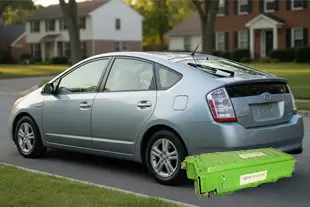
Prius (2012-2017)
Toyota Camry (2012–2017) Hybrid Battery Reconditioning faqs
Can a Toyota Camry hybrid battery be reconditioned?
Yes, most 2012–2017 Camry hybrid batteries can be reconditioned. The process tests all 34 NiMH modules, replaces weak ones, and balances voltage across the pack. It works best when cell failure is localized rather than widespread.
How much does it cost to recondition a Camry hybrid battery?
Reconditioning typically costs $1,000 to $2,500, depending on how many modules need replacement and your warranty. That’s roughly half the price of a new Toyota OEM battery, which runs $3,000 to $5,000.
How long does a reconditioned hybrid battery last?
A reconditioned Camry hybrid battery usually lasts 3 to 5 years. Lifespan depends on climate, driving habits, and how degraded the pack was before service.
What is the P0A80 code on a Toyota Camry hybrid?
P0A80 means “replace hybrid battery pack.” It usually triggers when one or more modules weaken enough to drag down the entire pack. Reconditioning often clears the code by replacing the failed modules and rebalancing the cells.
Is reconditioning a hybrid battery worth it?
Yes, for most Camry owners. It costs about half of a new battery and restores normal fuel economy and performance. It makes the most sense when you plan to keep the car another 3 to 5 years.
What's the difference between reconditioned and refurbished hybrid batteries?
Reconditioning restores your original battery by replacing only the failed modules and balancing the rest. Refurbishing rebuilds a pack using tested used modules from other batteries. Reconditioning keeps more of your original components.
Can reconditioning fix a hybrid battery warning light?
Yes. Reconditioning usually clears the red triangle warning and P0A80 code by restoring healthy voltage across all cells.
How do I know if my Camry hybrid battery is failing?
Watch for a sudden drop in fuel economy, the red triangle warning light, weak acceleration on hills, the gas engine running constantly at stops, and a louder hybrid cooling fan.
Can I drive my Camry with a bad hybrid battery?
Short distances are usually fine, but long trips aren’t recommended. A failing battery can trigger reduced-power mode and stress the inverter and motor-generator, leading to bigger repairs.
How long does it take to recondition a hybrid battery?
Most jobs take 4 to 8 hours. Timing depends on how many modules need replacement and whether deep discharge-charge cycling is required.
Does reconditioning void the Toyota warranty?
No, it doesn’t affect coverage on non-battery components. If your hybrid battery is still under Toyota’s 8-year/100,000-mile or extended 10-year/150,000-mile warranty, use that first.
Why does my Camry hybrid battery fail early?
Heat is the main cause. Camrys in hot climates like Texas and Arizona often see failure 2 to 4 years sooner. Stop-and-go driving, long idle periods, and a clogged cooling vent behind the rear seat also shorten battery life.
Where is the hybrid battery located in a Toyota Camry?
Behind the rear seat, between the cabin and trunk. The pack runs at around 245 volts, so removal should only be done by a trained hybrid technician.
Can a hybrid battery be reconditioned more than once?
Yes, but with diminishing returns. A second reconditioning can work if only a few new cells have weakened, but after that, full replacement is usually the better value.
What warranty comes with a reconditioned battery?
Most reputable providers offer 12 to 36 months, with 18 to 24 months being typical. Shops offering only 30 to 90 days usually signal lower-quality work.
Will my fuel economy improve after reconditioning?
Yes, in most cases MPG returns to the original 38–43 range within a few drive cycles. If it doesn’t fully recover, check spark plugs, air filters, and the 12V battery.
Is hybrid battery reconditioning safe?
Yes, when done by trained technicians. The Camry’s high-voltage pack makes DIY reconditioning dangerous, so always use a qualified hybrid shop.
What happens to the old battery modules?
Reputable shops recycle them through certified hybrid battery recyclers, recovering nickel and steel while safely disposing of hazardous components.