The Triangle of Doom Isn’t the End:
It always seems to happen at the worst possible moment.
You’re merging onto I-95 outside New Haven, crawling through Brooklyn traffic, or driving through a rainy evening in Hartford when suddenly a bright red warning triangle lights up on your dashboard.
Prius drivers know the symbol immediately. The infamous “Triangle of Doom.”
For many owners, that moment comes with a wave of panic. You might have heard the same story countless times: “If the hybrid battery goes, the car is basically done.”
But here’s the truth most dealerships never explain.
A failing Prius hybrid battery is rarely the end of the vehicle. In fact, in many cases it’s simply a signal that your battery needs professional inspection, rebalancing, or strategic replacement.
Over the past 10+ years servicing Toyota hybrids across New York and Connecticut, our technicians have diagnosed thousands of Prius battery packs, allowing us to identify failure patterns most general repair shops rarely encounter. Drivers assume they’re facing a $4,000–$6,000 replacement bill when in reality a smarter, more specialized solution exists.
Understanding that difference begins with knowing how Prius batteries actually fail—and how professionals diagnose them.
How To Check Prius Battery Health & Longevity.
When Toyota introduced the Prius, it changed the automotive industry forever.
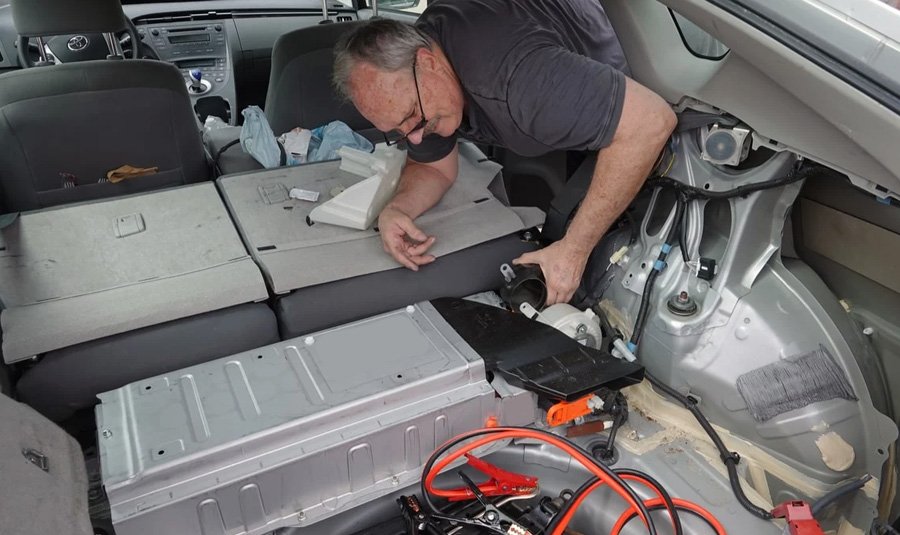
The secret behind that innovation is the Hybrid Synergy Drive, a system that seamlessly blends a gasoline engine with an electric motor. At the center of this technology sits a high-voltage battery pack located beneath the rear seat.
Most Prius models rely on Nickel-Metal Hydride (NiMH) modules, engineered to last for years of charging and discharging cycles.
According to Toyota hybrid engineering documentation, Prius NiMH battery packs are designed to operate within strict voltage and temperature ranges to maximize longevity and efficiency. When individual modules begin drifting outside those tolerances, the vehicle’s onboard computer detects the imbalance and triggers warning indicators.
But like every rechargeable battery—from laptops to smartphones—these cells eventually experience chemical degradation.
This isn’t caused by poor maintenance. It’s simply physics.
Over time:
The battery’s ability to store energy declines.
Internal resistance rises inside individual modules.
The system becomes unbalanced.
When that happens, the gasoline engine is forced to work harder to compensate. That’s when drivers begin noticing the warning signs:
Fuel economy suddenly drops.
Acceleration feels sluggish.
The battery charge gauge jumps erratically.
And eventually, the Prius computer triggers that dreaded warning triangle.
But the real story often lies deeper inside the battery pack.
Why Prius Batteries Fail Faster in NY and CT
Driving in the Northeast creates a “perfect storm” for hybrid degradation. It’s not just mileage; it’s the environment.
- The “Stop-and-Go” Stress Test
In cities like Manhattan, Brooklyn, and Queens, your battery never gets a break.
- Constant Cycling: Frequent idling in traffic forces the battery to power the AC and electronics alone.
- Deep Discharge: This heavy electrical load drains the cells faster than highway driving ever would.
- The “Northeast Climate” Factor
Our weather attacks your battery from the inside out:
- Winter Road Salt: Corrosive salt enters the cabin via shoes and humidity.
- Coastal Air: Salt air in New York and CT accelerates Verdigris (that green, crusty oxidation) on copper bus bars.
- Heat Traps: Corrosion creates electrical resistance, which generates heat. Heat is the #1 killer of Nickel-Metal Hydride (NiMH) cells.
Common Diagnostic Codes Prius Owners Encounter
When the Prius computer detects abnormal voltage differences between battery modules, it often stores diagnostic trouble codes such as P0A80 (Replace Hybrid Battery Pack) or P3011–P3024, which indicate voltage irregularities in specific battery blocks.
While these codes point toward battery imbalance, proper load testing is required to determine whether the issue involves a single failing module or broader pack degradation.
Professional Inspection vs. DIY Scanners
Many owners try to diagnose the “Triangle of Doom” with a $20 Bluetooth OBD-II scanner. While helpful, these tools often miss the “Cliff Effect.”
Why DIY Scanners Can Be Misleading:
- Static vs. Load: A module might look “healthy” while parked but collapse instantly under hard acceleration.
- The “Whack-a-Mole” Risk: Without professional data, you might replace one bad cell today, only to have the cell next to it fail two weeks later.
How To Test Prius Hybrid Battery: Our Professional Process.
- Internal Resistance Mapping: Identifying modules struggling to pass current.
- Voltage Delta Analysis: Measuring the “gap” between your strongest and weakest cells.
- Live Load Testing: Simulating real-world driving (hills and braking) to see how the pack actually breathes.
Toyota’s Hybrid Synergy Drive system used in the Toyota Prius was engineered to balance gasoline and electric propulsion for long-term reliability.
The Advantage of a Specialist
A general mechanic might see two hybrids a month. We see them every day. This specialization allows us to spot “ghost” issues that look like battery failure but aren’t:
- Clogged Cooling Fans: (Common in 2004–2009 models) which cause the battery to overheat.
- 12V Auxiliary Failure: A weak small battery can sometimes trigger “Big Battery” error codes.
- Inverter Patterns: Recognizing when the issue is actually in the power conversion system.
Prius batteries use Nickel-Metal Hydride (NiMH) modules designed by Toyota to operate within strict voltage tolerances across 28 individual cells.
Repair or Replace? Choosing the Right Battery Strategy
Every Prius has a different story. Whether you’re looking to hit 300,000 miles or just need the car to last two more years for a teenager, your repair strategy should match your goals.
At Aloy Hybrid, After inspecting and repairing hundreds of Toyota hybrid batteries across New York and Connecticut over the past decade, we believe in data-driven transparency. When a hybrid battery inspection confirms imbalance or failing modules, owners typically face three practical paths forward.
| Feature | New Battery Cells | Remanufactured Pack | Refurbished/Repair |
| Best For | Long-term owners (5+ years) | High-mileage daily drivers | Budget-conscious / Short-term |
| Process | Full replacement with 2026-spec OEM-grade cells. | High-capacity tested modules, balanced for performance. | Targeted replacement of specific failing modules. |
| Reliability | Highest. Resets the clock to “Factory New.” | High. Balanced to function as a matched system. | Moderate. Fixes the immediate “Triangle of Doom.” |
| Typical Lifespan | 8–10+ Years | 3–5 Years | 1–2 Years |
| Fuel Economy | Maximum (50+ MPG) | Restored to near-factory | Significant improvement |
| Warranty | Industry-leading (Multi-year) | Comprehensive 1–2 Year | Limited / Short-term |
In the Northeast market, Prius hybrid battery repair costs can vary widely depending on the condition of the pack. Targeted module repair is typically the most affordable option, while remanufactured battery packs provide a balance between longevity and cost. Brand-new battery packs offer the longest lifespan but represent the largest upfront investment.
Pro Tip: If your Prius is over 12 years old and showing multiple weak modules, a New or Remanufactured pack is almost always more cost-effective than a simple repair. Repeatedly “patching” a battery—sometimes called “whack-a-mole” repair—often leads to multiple service visits and higher labor costs in the long run.
The Advantage of Hybrid Battery Specialists
Hybrid vehicles require a very different level of expertise compared to traditional cars.
A general repair shop may only encounter a few hybrid battery issues each year. Specialists, on the other hand, work with these systems daily.
That experience matters.
Hybrid technicians understand the cooling systems inside different Prius generations, including the common fan blockages seen in 2004–2009 models. They also recognize inverter behavior and electrical patterns in later generations.
More importantly, they work with high-voltage safety equipment and precision diagnostic tools designed specifically for hybrid systems.
Sometimes what appears to be a battery failure is actually something much simpler, like a clogged cooling fan or a failing 12-volt auxiliary battery.
Proper diagnostics reveal the real cause before expensive parts are replaced unnecessarily.
All high-voltage work follows strict safety procedures including insulated tools and protective equipment.
Hybrid battery systems operate at voltages exceeding 200 volts, which is why professional technicians follow high-voltage safety protocols and use insulated tools designed specifically for hybrid electrical systems.
Every battery pack we install is tested using professional load simulation equipment before installation, ensuring balanced voltage across all modules.
Mobile Hybrid Battery Service Across NY and CT
One of the biggest challenges Prius owners face is what to do when the vehicle enters limp mode.
Driving long distances with a failing battery can be risky, and towing to a dealership often adds unnecessary expense.
That’s why mobile hybrid battery service has become increasingly popular across the Tri-State area.
Instead of bringing the car to the shop, technicians arrive fully equipped to perform battery diagnostics and replacement directly in the customer’s driveway or parking garage.
For many Prius owners in New York City, Long Island, Westchester, and Connecticut, this approach saves both time and towing costs.
Our hybrid specialists are trained specifically in Toyota high-voltage systems.
Most installations can be completed in just a few hours.
By the end of the visit, the vehicle is often back on the road delivering the fuel efficiency drivers originally fell in love with.
The Aloy Hybrid Standard: Experience You Can Trust
At Aloy Hybrid, hybrid batteries aren’t just another service—we specialize in them.
Our technicians work exclusively with Toyota hybrid systems and have spent years diagnosing the patterns that lead to battery failure.
Each battery we install is carefully tested to ensure it meets strict discharge performance standards. Modules are matched for capacity and resistance so they function as a balanced system rather than a collection of random parts.
We also inspect cooling systems, electrical connectors, and high-voltage wiring to ensure the entire hybrid system operates safely and efficiently.
Just as importantly, every removed battery is properly recycled, helping prevent hazardous materials from entering landfills.
Hybrid technology was built to be environmentally responsible, and we believe its repair process should reflect the same philosophy.
Investing in the Life of Your Prius
Many Prius drivers worry about the cost of hybrid battery repair.
But ignoring the problem often leads to bigger expenses.
A failing battery forces the gasoline engine to run more frequently, reducing fuel efficiency and increasing wear on surrounding components.
Drivers commonly experience fuel economy drops of 15 to 20 percent before addressing the issue.
Restoring the battery system often brings those numbers right back.
With proper maintenance and a healthy hybrid battery, many Prius vehicles continue running smoothly well past 250,000 miles.
About the Hybrid Battery Specialists Behind This Guide
This guide was prepared by hybrid battery specialists who have spent more than a decade diagnosing and repairing Toyota hybrid systems across New York and Connecticut. With thousands of Prius battery inspections completed in real-world driving conditions—from dense New York City traffic to Connecticut winters—our team has developed diagnostic methods designed specifically for aging hybrid battery packs.
The Road Forward
If your Prius is showing warning lights, struggling with acceleration, or losing fuel efficiency, the smartest first step isn’t guessing—it’s getting a professional hybrid battery inspection.
The Triangle of Doom may look intimidating, but in many cases it’s simply the car asking for attention.
With the right diagnostics and expert repair strategy, your hybrid can return to the quiet, efficient performance that made the Prius famous in the first place.
And for many drivers across New York and Connecticut, that journey back to 50-plus miles per gallon starts with a simple inspection.
Frequently Asked Questions (FAQ)
Q: Can I still drive my Prius with the Red Triangle on?
A: It is not recommended. The car may enter “Limp Mode,” limiting your speed and forcing the gas engine to work overtime, which can lead to expensive engine or transaxle damage.
Q: Why did my gas mileage (MPG) suddenly drop?
A: When battery cells weaken, the Hybrid Synergy Drive forces the gas engine to run constantly to keep the battery charged. A drop of 15–20% in MPG is often the first warning sign of a failing battery.
Q: Do you offer mobile service in my area?
A: Yes. We provide mobile hybrid battery diagnostics and installation across New York City, Long Island, Westchester, and Connecticut, saving you the high cost of towing to a dealership.
Q: How much does a professional Toyota hybrid battery health check cost compared to a dealership diagnostic?
A: While a dealership might charge $150–$250 just for a diagnostic, a professional Toyota hybrid battery health check cost is often much more affordable when bundled with a mobile service visit.